


Subject: We Need to Talk About Your “Death Star” (And How to Save Your Assets)
Dear Decision Makers,
Let’s be honest. Right now, your company’s core business logic is held together by digital duct tape, prayers, and a senior developer named “Dave” who is currently looking at beach houses in Bali.
If Dave leaves, or if JavaScript updates from version 234 to 567, your system doesn’t just “glitch”—it develops a mid-life crisis. Your invoices stop sending, your NPCs stop walking, and your CFO starts looking for a sturdy window to jump out of.
We are here to save your assets (and your sanity).
The Problem: You are Building Sandcastles in a Hurricane
Most software is built like a “Death Star.” It’s massive, expensive, and if a 19-year-old pilot (or a library update) hits that one specific vent, the whole thing explodes. Every time you “innovate,” you add more complexity. You aren’t building a company; you are building a Technical Debt Factory.
The Solution: Oro Playmaker – The “Centennial Stability” System
We didn’t build just another “cool app builder.” We built a Knowledge Vault.
Oro Playmaker is a system for the Secure Storage of Business Logic across Decades. We’ve cracked the code on how to make your software immortal.
Here is the “Magic” for the Boardroom:
- The Oro Brick (Atomic Intent): We force your developers to write code in tiny, “Atomic” pieces. They aren’t allowed to write spaghetti. They write “Bricks.” One brick does one thing (e.g., Calculate Tax).
- The Core Vault: The intent of your business (the rules, the math, the flow) is stored in a platform-agnostic “Core.” This never changes. It is the DNA of your company.
- The “Oro Fusion” Button: Your team builds complex systems by snapping bricks together. When they click “Build,” our system stitches them into a high-performance “Action” while keeping a digital map of every single atom.
Why the CFO will love us:
You stop paying for “Refactoring.” When technology changes, you don’t rewrite the system. You just swap the “Executable” part of the brick. It’s like changing the tires on a car instead of buying a new car every time the road gets repaved. ROI? We’re talking about a system that stays profitable for 100 years.
Why the CTO will finally sleep:
No more “Black Box” code. With Oro, every line of code has a “Passport” (// @oro.id). If something breaks in 2075, the system tells you exactly which brick is at fault. It’s transparent. It’s orderly. It’s beautiful.
Why the Owner can retire in peace:
You are no longer a hostage to your dev team. If your lead programmer leaves tomorrow, the Knowledge stays in the Oro Vault. The logic isn’t in their heads; it’s in the bricks.
The Bottom Line
Stop building disposable software. Start building a legacy. Oro Playmaker doesn’t just write code; it preserves the intelligence of your enterprise.
Let’s move your logic from the “Death Star” into the Oro Vault.
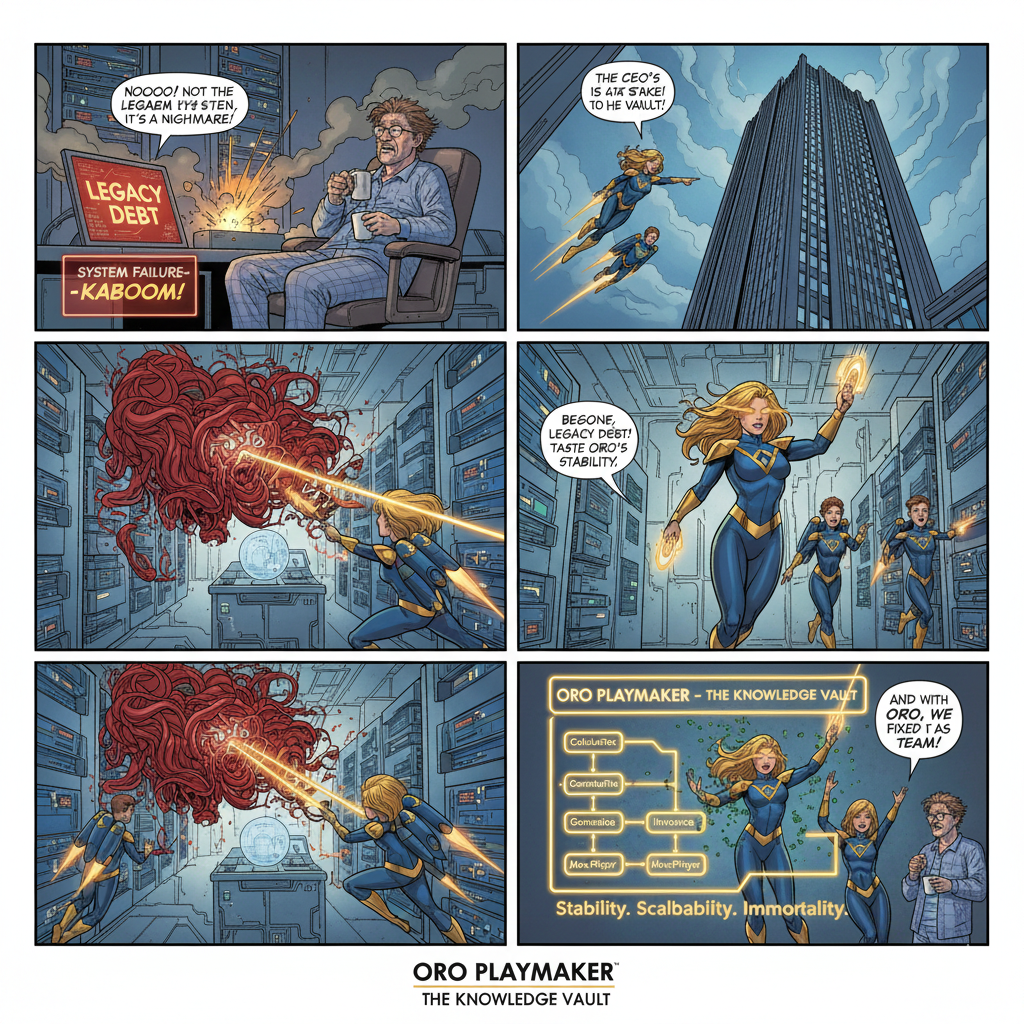
Oro Playmaker: Stability. Scalability. Immortality.
THE OBJECTION CRUSHER: What Your IT Team Will Say and Why They Are Wrong
Implementing Oro Playmaker is a paradigm shift. And every shift met with resistance. Here are the most common “buts” you will hear in the breakroom—and the ready-made counters to protect your millions.
1. The Objection: “This limits our creativity! Developers are artists; we need the freedom to code!”
- The Reality: Developer “freedom” is often just expensive chaos for the company. In Oro, we don’t limit creativity—we limit sloppiness.
- The Counter: “Architects have limits too (the laws of physics), yet they build skyscrapers. Oro provides the foundation so your creativity doesn’t collapse during the next update. We want architects, not chefs serving ‘spaghetti code’.”
2. The Objection: “Writing bricks with // @oro.id tags takes too much time!”
- The Reality: Yes, defining the intent takes 5% more time upfront. However, failing to define it generates 500% more cost when fixing bugs a year from now.
- The Counter: “Would you rather spend 5 minutes tagging a brick today, or 5 weeks hunting for a bug in 2027 when nobody remembers what the original coder was thinking? In Oro, we invest time now to buy back years of stability later.”
3. The Objection: “We already have GitHub and documentation; that’s enough!”
- The Reality: Traditional documentation is a fairy tale that becomes obsolete a week after it’s written.
- The Counter: “GitHub stores the code, but Oro stores the understanding. Documentation in Oro isn’t in a separate file—it’s woven into the DNA of the brick. If the code runs, the documentation is correct. It’s the only system that polices itself.”
4. The Objection: “This No-Code/Low-Code stuff is for amateurs. We are ‘PRO’ developers.”
- The Reality: Real professionalism is building systems that the company can maintain without being a hostage to a single individual.
- The Counter: “Being ‘PRO’ means building assets for the company, not creating a personal kingdom out of code that no one else can touch. Oro Playmaker is a tool for professionals who value their time and the company’s security.”
5. The Objection: “What if Oro Playmaker disappears from the market?”
- The Reality: This is the strongest point of your system. Because of atomization, even without the editor, you are left with clean, tagged, and perfectly documented code.
- The Counter: “That is exactly why we chose Oro. Even if the provider vanished, our business logic is saved in the
oro.idstandard. It is the most ‘portable’ system in the world. We aren’t locked into a vendor; we are locked into our own logic, which belongs to US.”
The Verdict for the Board:
Your developers might complain that you are “taking away their toys.” The truth is, you are giving them professional production tools. Oro Playmaker transforms IT from a “cost and risk center” into a “stable asset center.”
Ready to see the “Centennial Stability Certificate” every one of your actions receives after passing through our system?
P.S. Remember, CFO—every “it can’t be done” regarding Oro is actually a request for permission to keep generating technical debt at your expense.